RFID Basics
RFID and Your POS: Counting Inventory Without Replacing Your Checkout
RFID inventory counting does not replace your point of sale. Here is how it works alongside Shopify, Square, Lightspeed, or any POS you already run.
One of the first questions retailers ask about RFID is the one that stops a lot of projects before they start: do I have to replace my point of sale to use it? The short answer is no. RFID inventory counting is built to sit alongside the checkout system you already run, not to take its place.
It helps to see why, because the two systems are answering completely different questions.
Two systems, two jobs
Your POS is a transaction system. It rings up sales, takes payment, applies discounts, and records what left the store at the register. Shopify, Square, and Lightspeed all do this well, and most retailers have years of history, hardware, and staff habits built around the one they use.
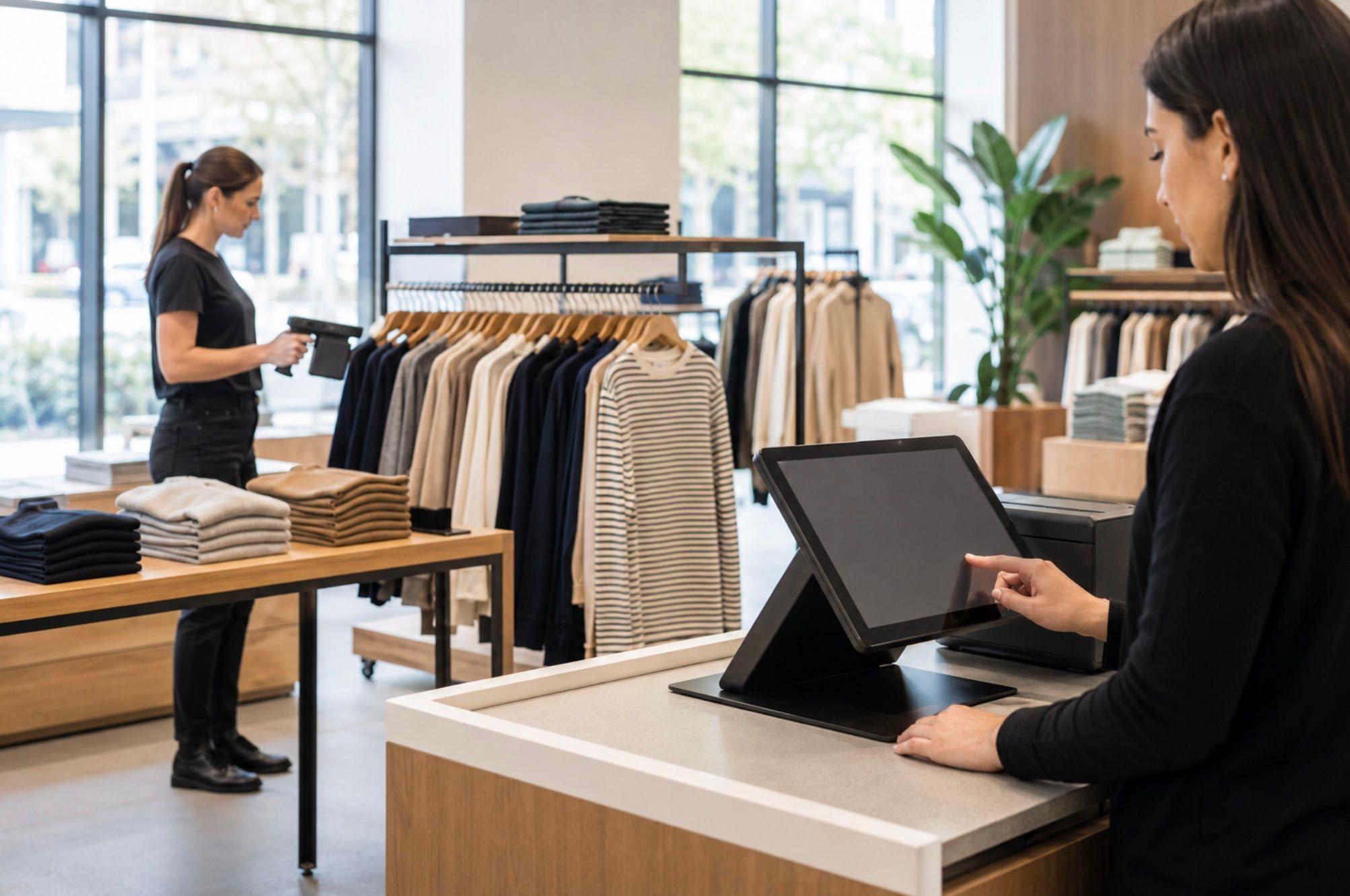
RFID is a counting system. It tells you what is physically present in the store right now: on the floor, in the stockroom, in the back. A handheld reader such as the C8001 sweeps a rack or a shelf and captures every tagged item in range, then the software resolves those reads into a real count by style, size, and color.
The POS knows what you sold. RFID knows what you actually have. Those are not the same number, and the gap between them is exactly the problem RFID is there to close.
Where the two systems meet
Think of your inventory record as the shared ground between them. Every sale at the POS lowers the expected count for an item. Every RFID cycle count measures the true count. When you compare the two, you find out where your records have drifted from reality.
That drift is normal in any store. Items get misplaced, received incorrectly, or counted wrong months ago, and the error quietly compounds. A POS on its own cannot catch this, because it only ever sees the items that pass the register. RFID gives you a fast, repeatable way to check the shelf against the system, so a discrepancy surfaces in days rather than at the annual count.
You do not have to wire the two together to get value. Many retailers start by running RFID counts in indexRFID, our inventory software, and using the results to correct the stock numbers in their POS. The count is the source of truth, and the POS gets updated to match it.
It works with the POS you already have
Because RFID counting lives in its own software layer, it is not tied to any one checkout brand. The workflow is the same whether you run Shopify, Square, Lightspeed, or something else entirely:
- Shopify. Keep selling online and in store through Shopify. Use RFID counts to keep the inventory quantities behind your listings honest, so online orders are placed against stock that is really there.
- Square. Square handles the register and payments. RFID handles the physical count, then you reconcile the two so your Square catalog reflects what is on the floor.
- Lightspeed. Lightspeed manages purchasing and sales. RFID gives you the frequent, accurate counts that purchasing decisions depend on.
- Any other POS. The principle does not change. The POS owns the transaction, RFID owns the count, and your inventory record gets the benefit of both.
The point is not that RFID plugs into a specific button inside your POS. It is that RFID gives you an accurate count you can trust, and that count makes whatever POS you already use more reliable.
A day in the workflow
Here is what this looks like in practice. The register runs all day as it always has, recording sales through your POS. Separately, a staff member walks a section of the store with the handheld reader and runs a cycle count, sweeping racks and shelves as they go. The count fills in as they move, no line of sight needed, no item handled one at a time.
When the count finishes, the software shows what is present, what appears to be short, and where the floor differs from the records. The team corrects the records, investigates anything that looks off, and moves on. Nothing about the checkout experience changed. The customer still pays at the same register, on the same system, the same way.
Over a few weeks, those frequent counts keep your inventory close to reality all year, instead of letting errors pile up until a once a year scramble.
You keep your checkout, you gain accurate counts
The fear that RFID means ripping out a working POS is what keeps a lot of stores stuck with inventory numbers they do not trust. It is also unfounded. You keep the checkout system your staff knows and your business runs on. What you add is a reliable way to know what is actually on your shelves.
That is the whole idea behind the way we built this. RFID inventory counting that works alongside the POS you already have, supplied and supported in the U.S. by Retail Security Group, which has been working inside U.S. retail since 2004.
If you want to see how counts would run in your store, the RFID starter kit is sized for a single location and includes the reader, the printer, labels, and a year of indexRFID. Or talk to us about what fits your setup.