Industry Guides
How to Roll Out RFID Across Several Stores
Rolling RFID out to more than one store works best in waves, not all at once. Here is how to sequence a rollout: which store goes first, what to standardize, and how the tools scale.
The biggest RFID rollouts in retail do not happen all at once. When JD Sports began putting RFID inventory tracking across its stores, it did not flip a switch chainwide. It started with a five store pilot in 2024, proved the workflow, and only then began scaling in waves, with hundreds of stores going live first and the rest of the European estate following through 2026. That sequencing is not a limitation of scale. It is the right way to do it, and the same logic applies whether you run three stores or three hundred.
If you operate more than one location, the question is rarely whether RFID counts help. It is how to bring it to the whole group without turning every store into a science experiment at the same time. Here is how to think about the order of operations.
Do not launch every store at once
The instinct with a group of stores is fairness: roll it out everywhere on the same day so no location feels left behind. Resist it. A first RFID count almost always surfaces things you did not expect, from how your vendors tag goods to where your records have quietly drifted. You want to meet those surprises in one store, with your full attention, not in ten stores at once with your attention split.
Sequencing also protects your staff. The people running the first count are learning a new tool and a new routine. If they learn it well in one store, they become the people who train the next, and the knowledge compounds as you go. Launch everywhere at once and every location is a beginner at the same time.
Choose the first store deliberately
Your pilot store is not just the closest one. Pick the location that will teach you the most while carrying the least risk if the first count is messy. In practice that usually means:
- A store you can get to easily. You will visit it more than you expect during the first few weeks. Proximity matters.
- A manager who is willing. The workflow lives or dies on the floor. A location led by someone curious about the tool beats a bigger store led by someone who has to be dragged.
- A representative product mix. If most of your stores sell apparel, pilot in an apparel store, not the one odd location that is mostly accessories. You want lessons that transfer.
- A backroom that is not chaos. A stockroom you can actually organize gives you a clean baseline. The messiest store is a later problem, not a first one.
Start there with one category or one stockroom rather than the whole store. A first count of a defined area sets a baseline and shows you the gap between what the system thought you had and what is really on the shelf.
Standardize the routine before you scale it
The point of a pilot is not just to prove RFID works. It is to turn a loose set of good intentions into a written routine that any store can follow. Before you move to store two, you should be able to answer, on paper:
- Where do tags come from. Do vendors apply them at the source, or do you encode in store during receiving? Blank labels can be encoded one at a time straight from the C8001 handheld in the indexRFID app, or printed and encoded in volume on the C8005 printer from your receiving data.
- Which labels go on which products. An apparel store leans on the C8102 hangtag, a boxed goods store on the C8101 adhesive label, a jewelry case on the small format C8103. Settle this in the pilot so store two is not relitigating it.
- How often each area gets counted. Many stores count high movement categories weekly and the full floor on a longer cadence. Write down the cadence so it survives a staff change.
- Who owns the count and who reviews the discrepancies. A routine without an owner quietly stops happening.
When those answers are stable, you have something to copy. That is what makes the second store faster than the first, and the tenth faster than the second.
The tools travel with you
One reason multi location rollouts are less daunting than they look: the hardware and software do not change from store to store. The C8001 handheld reader, the C8005 printer, and the label families are the same tools whether you tag your first rack or your fiftieth. There is no separate enterprise system waiting on the other side of some store count threshold.
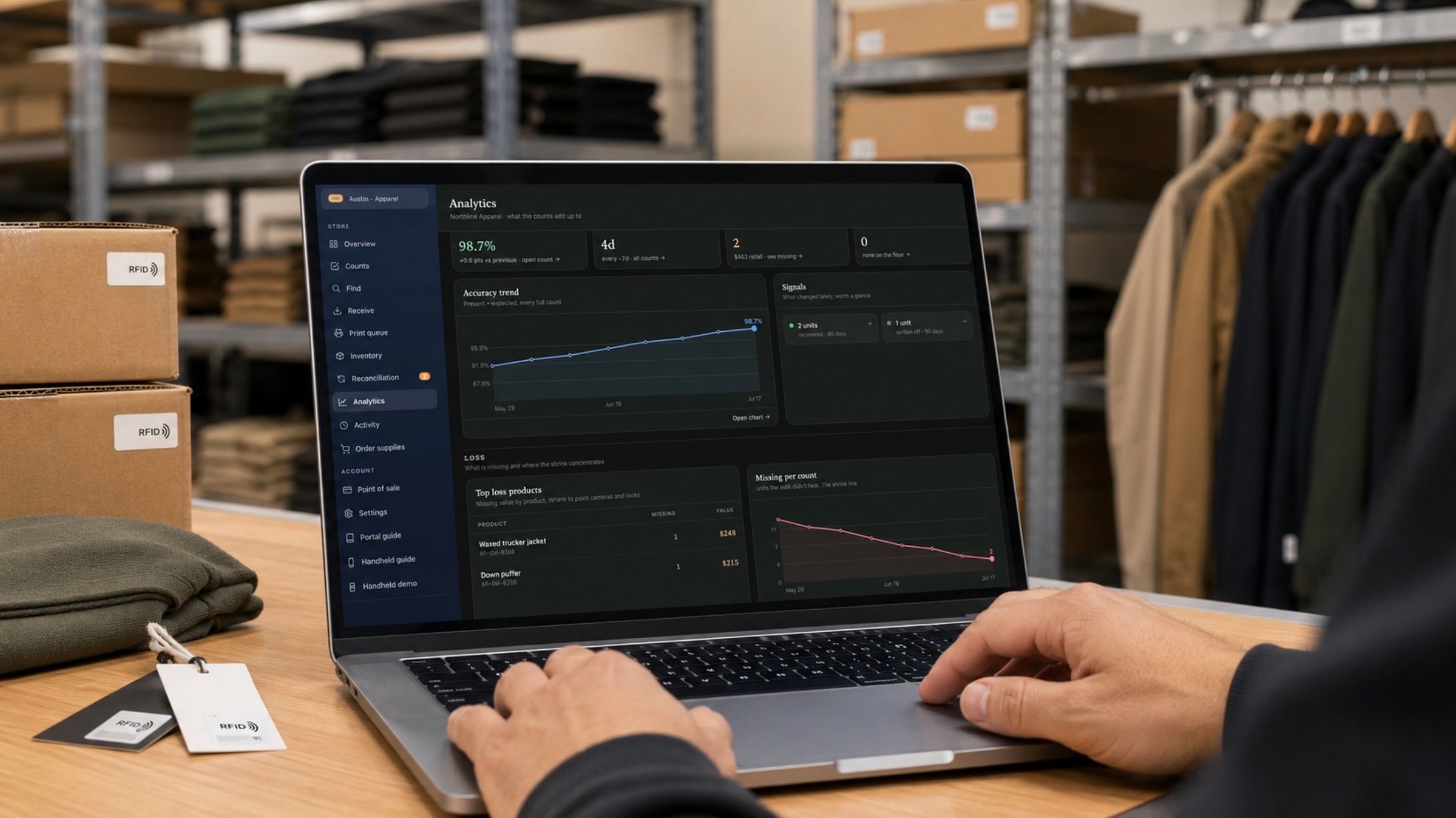
The software scales the same way. indexRFID is licensed per location, so each store gets its own catalog, its own counts, and its own history. You import a store’s product list from a CSV file in the portal, or sync it in from Shopify, and re importing the same file updates products in place as the assortment changes. Receiving, counts, imports, and sync activity are logged per store, so a regional manager can see where each location stands without standing in the room. Because every store uses the same reader and the same routine, the count you trust in the pilot means the same thing in every location that follows.
Sequence the rest in waves
With a proven routine and a store that runs it well, expand in deliberate groups rather than all at once. A common pattern is to move next to the stores most like your pilot, where the same product mix and the same labels apply with little change, then take on the harder locations once the routine is second nature. Stagger the go live dates so your experienced people can be present for each new store’s first count. The store that went first becomes the template, and often the training ground, for the ones that follow.
There is no fixed number of stores this stops working at. What changes as you scale is not the technology. It is how well rehearsed your routine is by the time it reaches the last store.
Where to start
If you run more than one store and want RFID counts across the group, start with one location and one category, prove the routine, then let it spread. The RFID starter kit is sized for a single location and includes the reader, the printer, labels, and a year of indexRFID, which makes it a natural fit for a pilot store.
Retail Security Group supplies and supports the full line in the U.S. and has been working inside U.S. retail since 2004. If you want help planning the order of a multi store rollout, talk to us and we will walk through it with you.