Industry Guides
RFID for Peak Season: Keeping Your Count Honest Through the Rush
Your busiest weeks are also the weeks your inventory count drifts fastest. Here is how frequent RFID cycle counts keep records close to reality when volume spikes.

Peak season is already here, and it arrived early. The National Retail Federation expects back to school and back to college spending to set records in 2026, with college shoppers and their families projected to pass 100 billion dollars for the first time, and two thirds of shoppers had already started buying by early July. Ahead of that demand, many retailers pulled inventory forward to get in front of a new round of tariffs, which means more stock landed in stores sooner and is sitting in backrooms longer than usual. All of that adds up to one uncomfortable fact for anyone who runs a store: your busiest weeks are also the weeks your inventory count is most likely to be wrong.
The count does not drift because your team gets careless. It drifts because peak season stacks up every condition that pulls the physical shelf away from the record, all at once.
Why your count drifts fastest when you are busiest
In a slow month, inventory error accrues slowly. A unit gets misplaced here, a return goes back to the wrong shelf there, and the gap between your records and your shelves widens a little at a time. Peak season compresses months of that drift into weeks.
- Volume. More units sell, more units restock from the back to the floor, and every one of those moves is a chance for a style to end up in the wrong place or a count to slip.
- More hands. Seasonal staff are still learning where things live and how the store is organized, so misplacements climb exactly when there is no time to chase them down.
- Constant movement. Promotions, markdowns, and floor resets shuffle product around, and a unit that moved without being recorded is a discrepancy waiting to surface.
- Returns. Returns spike after every peak, and a returned unit that is not verified back into the count is stock you own but cannot see.
None of these is dramatic on its own. Together, during the rush, they push your records out of line faster than any other time of year.
The annual count is the wrong tool for the rush
Most stores still lean on one big count a year, usually squeezed into a slow week with the doors closed or the clock run late. That model assumes error builds up gradually, so checking once is enough to reset it. Peak season breaks that assumption. The drift is happening now, in the weeks that matter most, and you cannot shut the floor down in the middle of your busiest stretch to count it.
What peak season actually calls for is the opposite of the annual count. Not one slow, total count when things are quiet, but a fast count you can run often, even in the middle of a shift, without closing anything. That is the cadence RFID was built for.
How RFID holds the count together under load
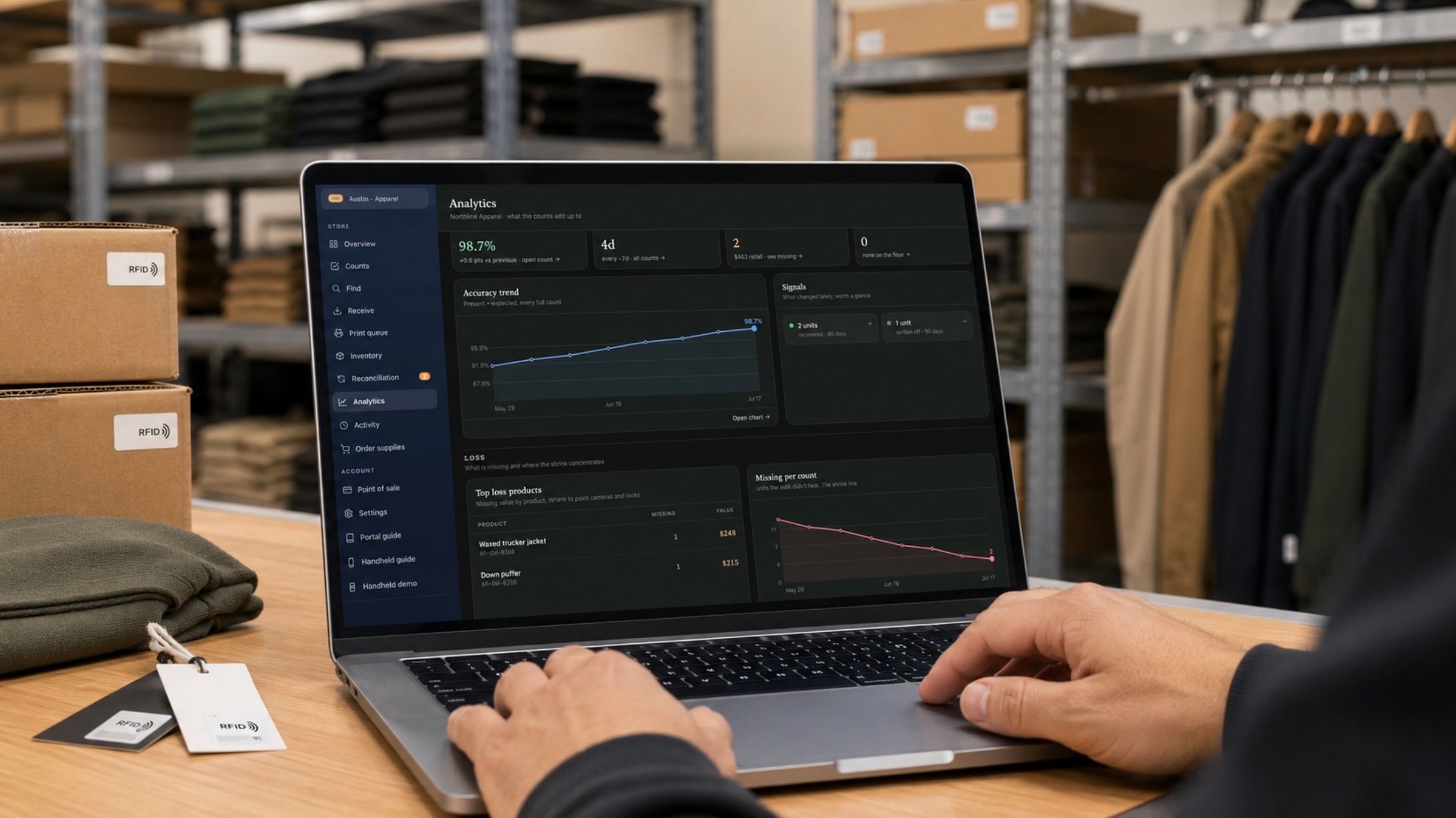
An RFID cycle count replaces item by item scanning with a single sweep. A staff member walks a section with the C8001 handheld reader and it captures every tagged item in range as they move, no line of sight and nothing handled one unit at a time. indexRFID, the inventory software, resolves those reads into a real count by style, size, and color, then shows you what is present, what appears short, and where the floor differs from your records.
The point for peak season is speed, because speed is what makes frequent counting realistic when the store is slammed. One apparel retailer recently reported counting a store of roughly 3,500 items in about 25 minutes with RFID. At that pace, counting a section every morning before you open, or running a full store count once a week, stops being a special event and becomes part of the routine. And because the count repeats, your records stay close to reality through the whole season instead of sliding until January. Lululemon reached roughly 98 percent inventory accuracy on the back of that exact habit, weekly cycle counts rather than one annual scramble.
Accuracy is what keeps online orders alive during peak
Peak season is also when ship from store and buy online pickup in store volume climbs the hardest, and both depend entirely on the count being right. When your website shows a unit as available and the shelf turns out to be empty, the order cancels, and it cancels at the worst possible moment, in front of a customer who was ready to buy. The frequent counts that keep your floor honest are the same counts that keep the quantities behind your online listings honest, so orders get placed against stock that is actually there.
Get ahead of the rush, not caught in it
The worst time to start an inventory project is the middle of a peak you are already losing control of. The best time is now, before the heaviest weeks land. You do not tag the whole store on day one. Most retailers start with one category or one stockroom, confirm the workflow, and expand from there.
If your suppliers do not source tag yet, receiving is the natural place to tag. The C8005 printer prints the readable face and encodes the RFID identifier in the same pass, so you apply a C8102 hangtag to apparel or a C8101 adhesive label to a boxed item as stock is checked in. The hardware is the same whether you run one store or fifty, so the workflow you set up for this season is the one you keep for the next.
The RFID starter kit is sized for a single location and includes the C8001 reader, the C8005 printer, labels, and a year of indexRFID. It is supplied and supported in the U.S. by Retail Security Group, which has worked inside U.S. retail since 2004.
If you want to get a fast, repeatable count in place before your next peak, talk to us about where to start.