Industry Guides
Not All Shrink Is Theft: Separating Real Loss From Record Error With RFID
A large share of what stores write off as shrink is inventory record error, not theft. Here is how frequent RFID cycle counts tell the two apart.

Shrink is back near the top of every retail operations meeting, and the number keeps getting bigger. In its last full survey, the National Retail Federation put annual U.S. retail shrink at roughly 112 billion dollars. Then in 2024, after more than three decades, the NRF stopped publishing that annual shrink report, saying a single broad study no longer captured what was actually happening. More recent 2026 loss benchmarking lands in a similar range and keeps arriving at the same uncomfortable point: a large share of what stores book as shrink is not theft at all. It is bad data.
That distinction matters more than it sounds, because you cannot fix a problem you have misdiagnosed. If half of your shrink is really misplaced, mis-received, or miscounted stock, then more cameras and more guards will never move the number. The fix is knowing what you actually have. That is exactly what RFID cycle counts are built to tell you.
What shrink actually measures
Shrink is a subtraction. It is your book inventory, what the system says you should have, minus your counted inventory, what a physical count says you really have. Whatever is missing gets labeled shrink and, too often, quietly assumed to be theft.
The problem is that the subtraction lumps two very different things into one number:
- Real loss. Product that has genuinely left the building without a sale. External theft, internal theft, unrecorded damage.
- Record error. Product that is still yours, or was never yours, but the records are wrong. The count is off, not the shelf.
Both show up as a gap between the book and the count. Neither is separated out by the annual number on its own. So the store writes a check against theft when a big piece of the gap was never stolen.
Where record error comes from
Record error is not a sign of a sloppy store. It is the normal friction of moving thousands of items through receiving, the stockroom, the floor, transfers, and returns. Common sources:
- Receiving mistakes. A carton is logged as 50 units when 45 arrived, or a substitution is never keyed. The record is inflated from the first day.
- Misplaced and stranded stock. An item sits in the wrong bin, behind other product, or in a backroom overflow. It is present and sellable, but no count finds it, so it reads as gone.
- Mis-scans and unit errors. A pack scanned as a single, a size or color keyed to the wrong SKU, a manual adjustment entered against the wrong item.
- Transfer and return errors. Stock sent between stores that is received on one side and not the other, or a return put back into sellable count that should not have been.
Every one of these creates phantom inventory: the system expects units that are not really where it thinks they are. Studies of inventory record accuracy have found error rates that are startling. A landmark analysis of nearly 370,000 records across 37 stores found 65 percent of them inaccurate, and the Auburn University RFID Lab puts typical retail inventory accuracy, without item level RFID, at roughly 65 to 75 percent. When one in three records is wrong, a chunk of your shrink was authored by the record, not a thief.
Why the annual count hides the answer
A once a year physical count is the worst possible tool for telling loss from error. By the time you count, the discrepancy has been building for twelve months. You find that an item is 8 units short, but you have no idea when it went short, whether it was ever really there, or where it might be sitting right now. The trail is cold. So the unexplained gap gets rolled into shrink, and shrink gets read as theft, and the real cause is never found.
Frequency is what breaks that cycle. When you count often, each discrepancy is small, recent, and traceable. If the floor came up two short on Tuesday, you can walk the stockroom on Tuesday and often find both units mis-shelved. That is the difference between an investigation you can actually run and a year end write off you can only accept.
How RFID cycle counts separate the two
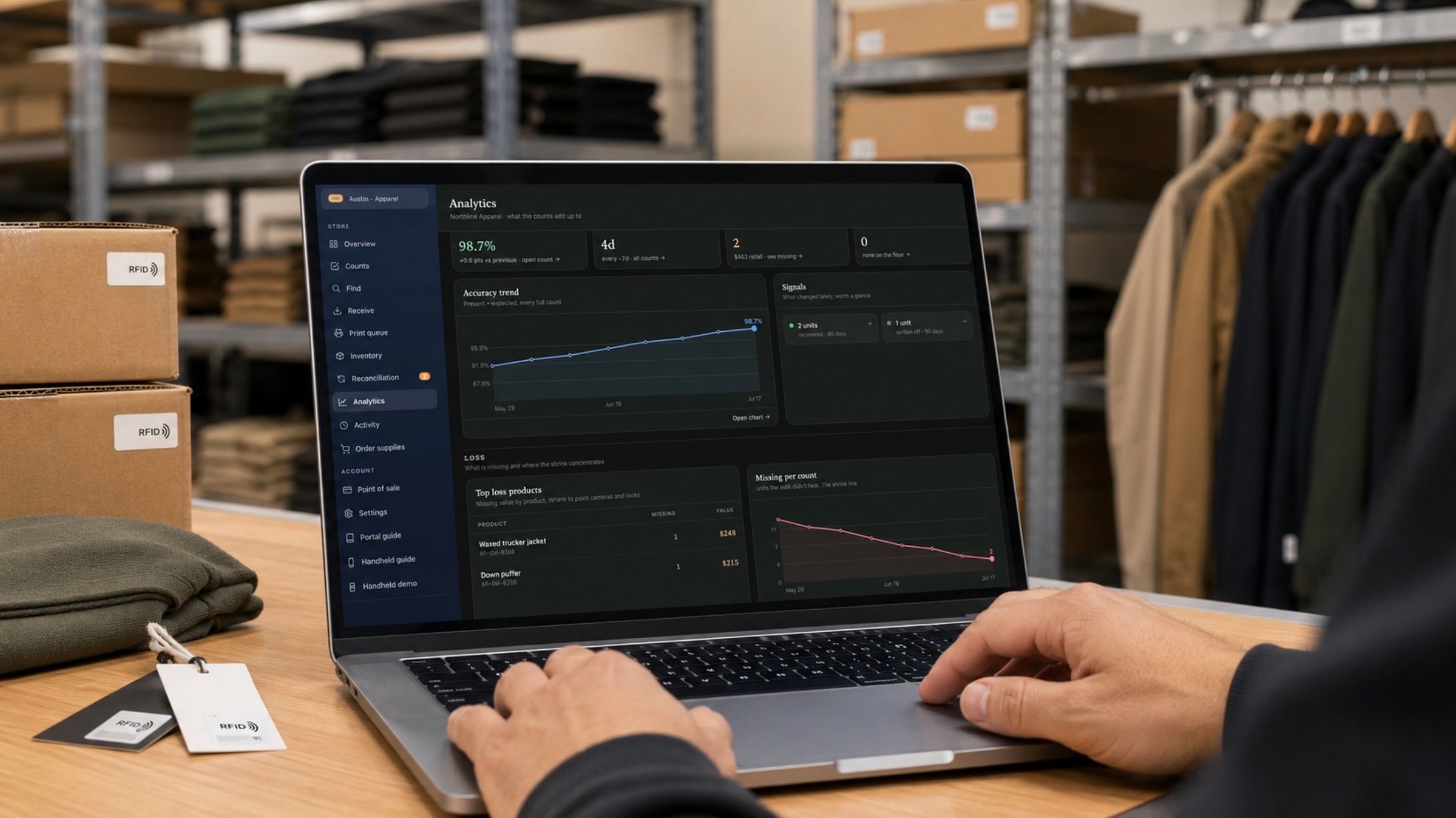
An RFID cycle count is fast enough to repeat weekly, which is what makes the separation possible. A staff member sweeps a section with a handheld reader such as the C8001, and the reader captures every tagged item in range in one motion, no line of sight and no handling items one at a time. indexRFID resolves those reads into a real count by style, size, and color and shows exactly where the floor differs from the record. Our guide on how RFID inventory counting works walks through the mechanics.
Here is how that turns a shrink guess into an answer:
- Count the floor, then count the back. If the system says 12 and the floor shows 10, a second sweep of the stockroom often finds the missing 2 sitting in the wrong place. That is found stock, not loss. Much of what looks like shrink is product still in the building.
- Catch receiving errors at the door. Counting a shipment as it arrives, rather than months later, surfaces the 45 versus 50 gap while you can still correct it against the record.
- Isolate the genuine loss. Once misplaced and mis-received stock is accounted for, what remains, consistent, repeatable, unexplained, is your real shrink. Now loss prevention attention goes where product is truly leaving instead of chasing ghosts.
RFID does not replace your point of sale in any of this. The POS knows what you sold. RFID knows what you physically have. The gap between them is the shrink you are trying to explain, and the count is the source of truth used to correct the records. For more on that split, see RFID and your POS.
Match the tag to the category
Shrink tends to concentrate in specific categories, and the tag has to fit the product. Apparel and footwear read well on printed C8102 hangtags, which sit away from the garment body. Boxed goods such as cosmetics and small electronics take flat adhesive C8101 labels. High value small items like rings and watches use the small format C8103 jewelry tag. Keep in mind that metal and liquids interfere with UHF signals, so jewelry, cosmetics, and canned or bottled goods need the label format and placement matched to the material. You do not tag the whole store on day one. Most retailers start with one high shrink category or one stockroom, confirm the workflow, and expand.
Fix the right problem
The retailers who get shrink under control are not the ones who spend the most on security. They are the ones who stop treating a data problem as a theft problem. Separate record error from real loss, and the number you are left with is smaller, honest, and finally actionable.
Retail Security Group supplies and supports the full RFID line in the U.S., the C8001 reader, the C8005 printer, the C8101, C8102, and C8103 labels, and indexRFID software, and has worked inside U.S. retail since 2004. If you want to see how counts would run in your store, the RFID starter kit is sized for a single location and includes the reader, the printer, labels, and a year of indexRFID. Or talk to us about the category where your shrink is worst.
Sources
- NRF: National Retail Security Survey 2023
- Retail Dive: After more than 3 decades, NRF won’t publish its annual shrink report this year
- Retail Brew: NRF pulls shrink report as it reevaluates tools for tracking theft
- Appriss Retail: The 2026 Total Retail Loss Benchmark Report
- ECR Retail Loss: Predicting Inventory Record Inaccuracy
- DeHoratius and Raman, “Inventory Record Inaccuracy: An Empirical Analysis,” Management Science (2008)
- Auburn University RFID Lab: Inventory Accuracy