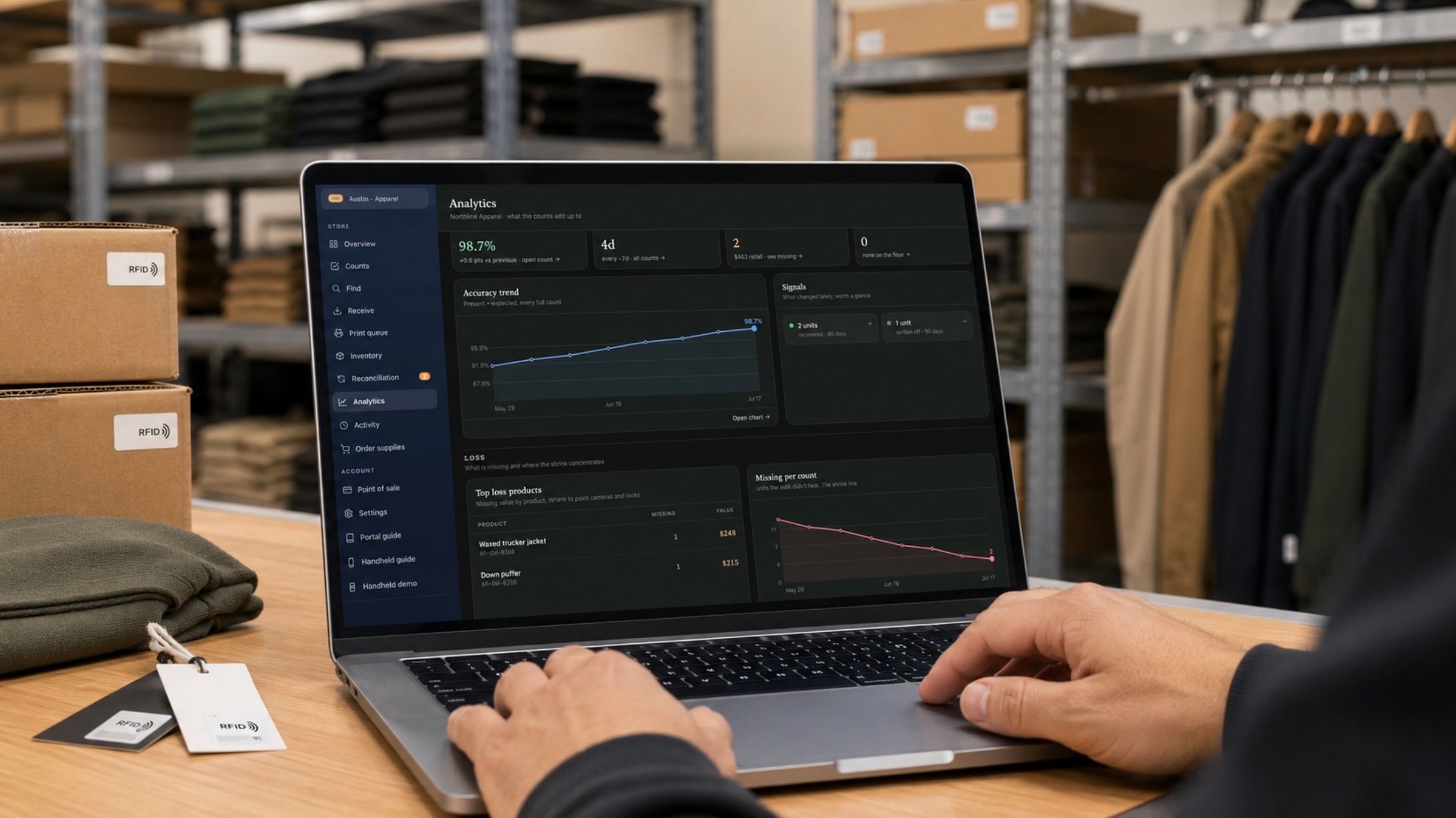
Industry Guides
RFID at Receiving: Catch Shipment Errors Before Stock Hits the Floor
Most inventory error is born at the loading dock, not the sales floor. Here is how RFID checks an inbound shipment against your purchase order in one sweep, before the stock is put away.
The biggest RFID story of 2026 is not happening on the sales floor. It is happening upstream, at the loading dock and the receiving table, where a delivery lands and someone has to confirm that what is in the boxes matches what the purchase order promised. Retailers who already tag their shelves are now pushing RFID back toward their suppliers, because that is where a surprising share of inventory error is actually born. Walmart has extended its tagging requirement across most of its merchandise categories, and the Auburn University RFID Lab, which studies exactly this brand to retailer handoff, broke ground on a larger facility in 2026 to keep the research going.
The number behind the push is worth sitting with. When the Auburn RFID Lab and GS1 US ran their Project Zipper study across more than a million items from five retailers and eight brands, they found that without RFID, 69 percent of inbound orders contained a discrepancy between what the brand shipped and what the retailer received. That is not a rounding error. Roughly seven in ten shipments were wrong in some way. With item level RFID reconciling the two sides, the same orders reached 99.9 percent accuracy.
Most stores never catch those errors, because they never check. A delivery arrives, someone glances at the carton count, signs for it, and wheels it into the back. The mistakes surface weeks later as phantom inventory, a style that will not reconcile, or an online order placed against a unit that was never actually delivered.
Why receiving is where inventory error begins
Your inventory record is only as good as its starting point. If a shipment gets logged as complete when two units are short, every count and every reorder after that inherits the mistake. Receiving is the first moment a store’s records touch physical reality, and in most stores it is the least controlled moment of the whole cycle.
The pressure is real. Deliveries arrive during business hours, staff are thin, and hand counting a mixed apparel shipment against a packing list is slow and error prone. So the check gets skipped or rushed. A carton labeled for one style turns out to hold another. A polybag is missing three units. A size run is short at the top and long at the bottom. None of it is visible from the outside of the box, and none of it shows up until it has already polluted the count.
What an RFID receiving check actually does
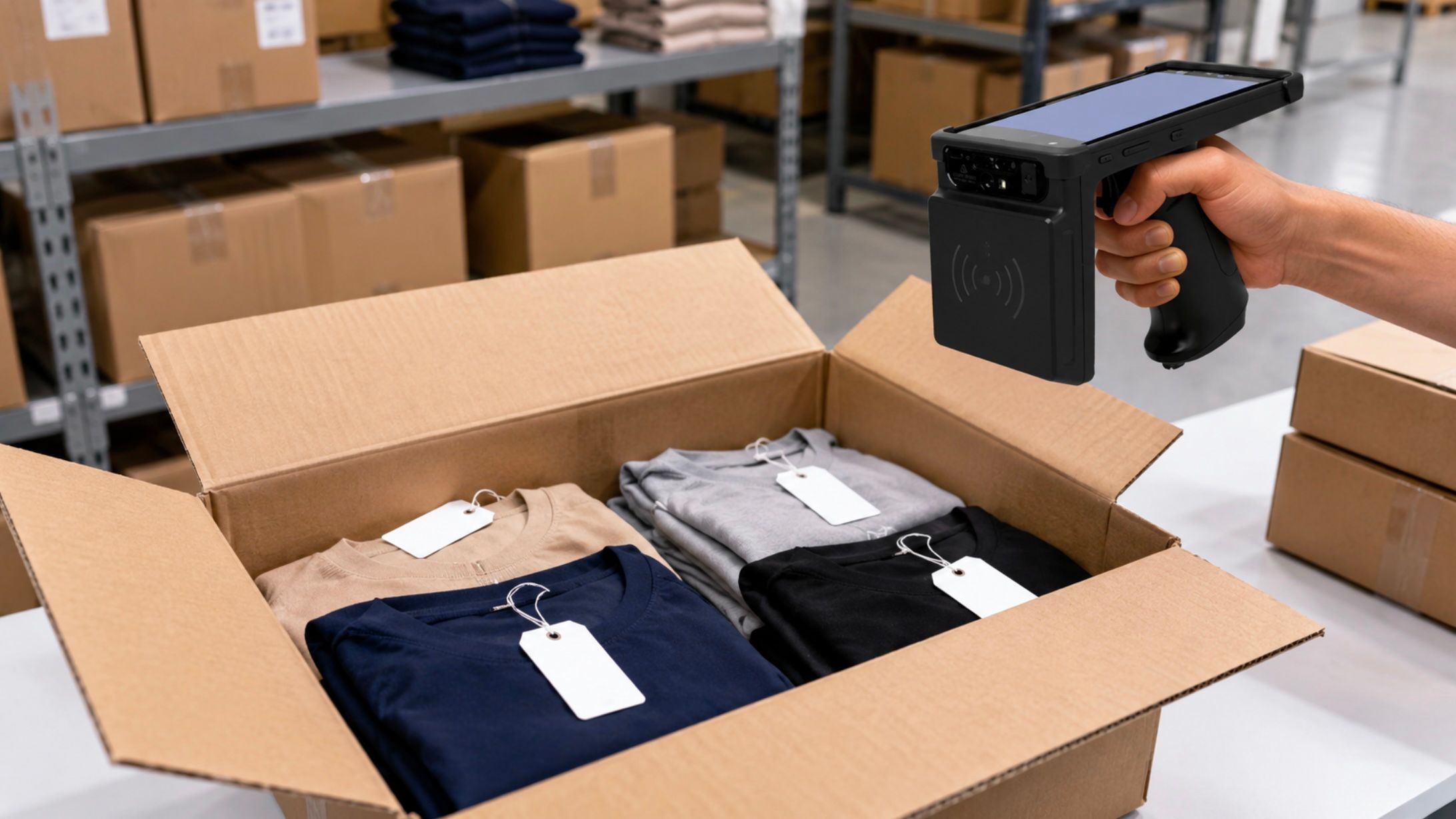
An RFID receiving check replaces the hand count with a single sweep. As a carton comes in, a staff member passes the C8001 handheld reader over it and captures every tagged item inside in one motion, no line of sight and no unpacking one unit at a time. indexRFID, the inventory software, compares those reads against what the shipment was expected to contain and shows you the result in plain terms: what was expected, what actually arrived, what is short, and what showed up that should not have.
Instead of a signature on a delivery slip you never verified, you get a reconciled receiving report in minutes. A short ship is flagged at the dock, while you still have the paperwork open and a case for a chargeback or a corrected invoice. The stock that does check out goes into your count as confirmed, not assumed.
Two ways a delivery can arrive
How you run the check depends on whether the goods are already tagged when they reach you.
- Source tagged shipments. More brands now apply RFID hangtags and labels during manufacturing, which is the upstream shift driving RFID in 2026. When goods arrive already tagged, receiving is pure verification: you sweep the carton and indexRFID verifies the tags against what was expected. This is the workflow Project Zipper measured, and it is the one that reaches near perfect accuracy.
- Untagged shipments. If your suppliers do not source tag yet, receiving is the natural place to tag. The C8005 printer prints the readable face and encodes the RFID identifier in the same pass, so you apply a C8102 hangtag to apparel or a C8101 adhesive label to a boxed item as it is checked in. You still hand count that first delivery, but every count after it is an RFID count, and the delivery is digitized from the moment it hits your floor.
Either way, the item is in your system with a unique identifier before it ever reaches a shelf.
What the check catches that a carton count misses
A carton count confirms that the right number of boxes arrived. It says nothing about what is inside them. An RFID receiving check works at the item level, so it surfaces the errors that actually cost you:
- Short ships and over ships, down to the individual unit rather than the case.
- Substituted styles, sizes, or colors, where the quantity is right but the contents are wrong.
- Mixed or mislabeled cartons, where a box is packed differently than its label claims.
- Duplicates and cross contamination between two orders received on the same day.
Each of those, left uncaught, becomes a discrepancy you spend hours investigating months later. Caught at receiving, it is a two minute conversation with the supplier.
Where to start
You do not need to overhaul receiving to try this. Most stores start with one supplier or one category, run the sweep on incoming deliveries for a few weeks, and watch how often the shipment and the paperwork disagree. The hardware is the same one you would use for floor counts, so a receiving check and a cycle count run on the same reader and the same software.
The RFID starter kit is sized for a single location and includes the C8001 reader, the C8005 printer, labels, and a year of indexRFID, which is everything a store needs to both verify tagged deliveries and tag untagged ones at the dock. It is supplied and supported in the U.S. by Retail Security Group, which has worked inside U.S. retail since 2004.
If you want to see how a receiving check would run on your deliveries, talk to us about your categories and your suppliers, and we will help you scope a first pass.
Sources
- RFID Journal: Project Zipper Finds Order Accuracy Jumps to Nearly 100 Percent With RFID
- GS1 US: EPC/RFID Retail Supply Chain Data Exchange Study (Project Zipper) Executive Summary
- Supply Chain Dive: RFID can achieve near 100% order accuracy, study says
- IDTechEx: How Will Walmart’s RFID Mandate Impact RFID Adoption in Retail?
- Auburn University Harbert College: Auburn Research and Technology Foundation Breaks Ground on New RFID Lab