Industry Guides
RFID for Jewelry Retail: Tracking Small, High Value Inventory
Jewelry is the most valuable inventory in the store and the slowest to count. Here is why RFID fits the category, the engineering problem it had to solve, and what a rollout looks like.
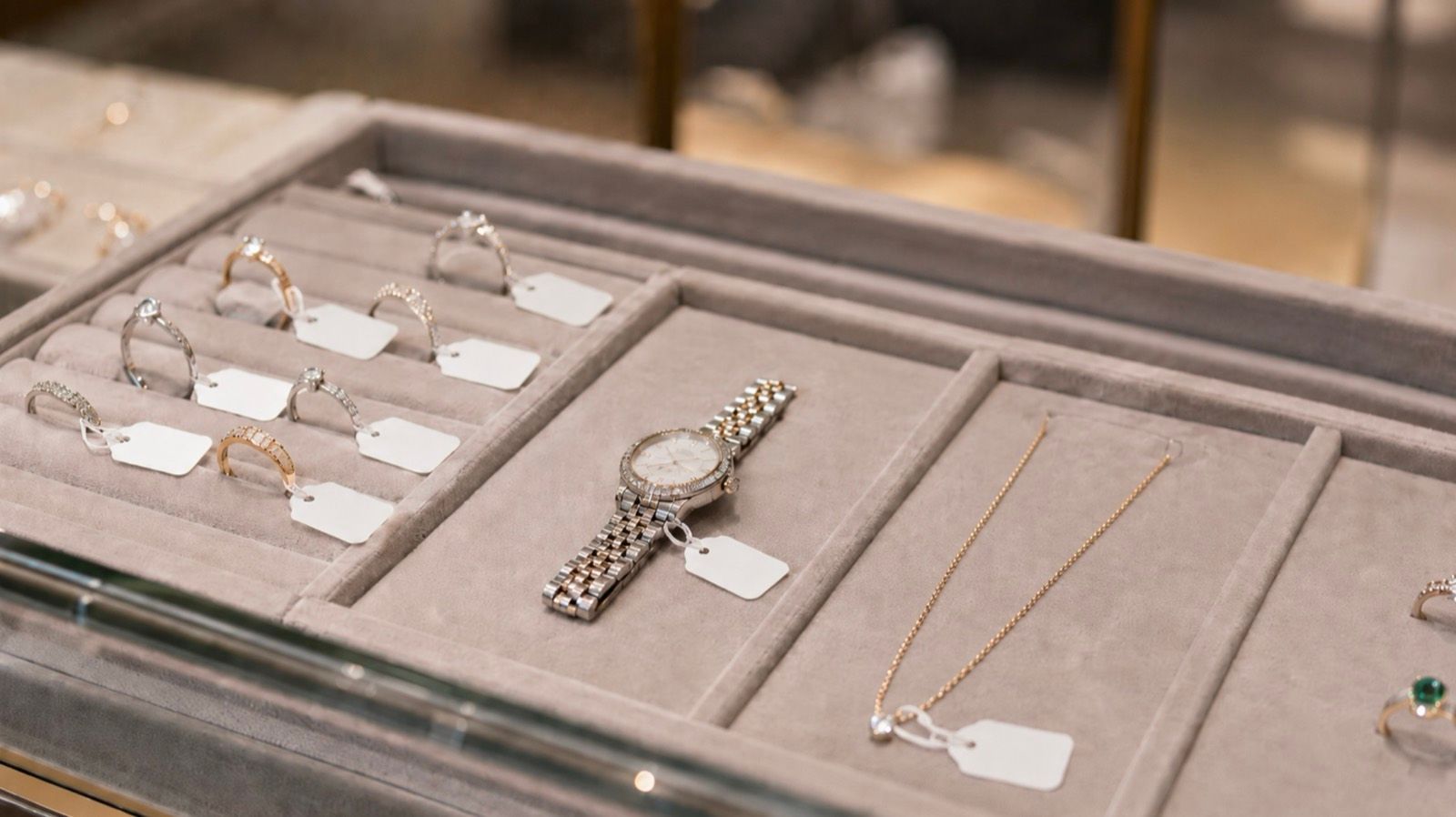
Jewelry is the most valuable inventory in retail by a wide margin. A single display case can hold more retail value than an entire apparel floor. Yet most jewelers still count that inventory the slowest way possible, by hand, piece by piece, often with two staff members verifying each case at open and close. RFID changes that math, and the reasons it fits jewelry are specific to how the category is bought, displayed, and sold.
Why jewelry was built for RFID
RFID rewards categories where every item has real value and a unique identity. Jewelry has both. Unit values are high, every piece is an item level SKU, and the counting habit is already frequent because the merchandise lives locked in cases and gets reconciled daily. The same conditions that made apparel the first category to adopt RFID at scale, item level goods with real value and growing omnichannel demand, are even more concentrated inside a jewelry case. For the apparel version of this story, see our guide on RFID for apparel retail, from stockroom to sales floor.
The hard part is metal and size
Jewelry is also the hardest retail category to tag, and for years that kept it out of RFID. Standard UHF labels fail near metal. A precious metal surface reflects the reader’s signal and detunes the tag’s antenna, often cutting read range close to nothing. A gold ring or a pair of earrings also cannot carry a large swing ticket the way a sweater can. Solving jewelry meant purpose built tags, compact loop or barbell tags small enough to hang from a ring, a watch, or a fine chain, and tuned to read reliably at close range. The RSG C8103 jewelry tag is that form factor. It is the reason a category that looks impossible for RFID on paper works in practice. For how it compares to the other formats, see choosing the right RFID label for your products.
What Chow Tai Fook proved
The clearest large scale example is Chow Tai Fook, one of the largest jewelers in the world. The company built item level RFID into both its distribution centers and its retail stores, using handheld readers so store staff could audit a location’s inventory in under 30 minutes, against the hours a manual count required. The deployment won multiple industry awards for RFID implementation in 2014. Treat the company’s own numbers as reported rather than independently audited, but the direction is consistent with every other serious rollout: tag at the item level, count often, and stop guessing.
Why the count gets faster
The speed comes from physics, not marketing. A barcode needs line of sight and one scan per item, so a case of several hundred pieces is a slow manual job and a full store can take hours. A UHF reader energizes every tag in range at once and reads them in bulk, with no line of sight required. The C8001 handheld group reads more than 200 tags per second, which is what turns a multi hour count into a count measured in minutes. That speed is what makes frequent counting practical. A jeweler can reconcile every case daily instead of dreading a quarterly physical inventory. The underlying mechanics are the same for every category, walked through in how RFID inventory counting works.
Why accuracy matters more in jewelry
Most stores start from worse inventory accuracy than they think. A landmark study found 65 percent of nearly 370,000 inventory records inaccurate across a single retailer’s stores (DeHoratius and Raman, Management Science, 2008), and the Auburn University RFID Lab puts typical retail inventory accuracy without item level RFID at roughly 65 to 75 percent. In apparel, a counting error is usually a missed sale. In jewelry, where a single SKU can be worth thousands of dollars, the same percentage error is a far larger number on the balance sheet, and a write down at year end may reflect a bad count rather than a confirmed loss. Item level RFID is how jewelers close that gap. In supply chain testing, the Auburn University RFID Lab and GS1 US found RFID pushed shipment order accuracy near 99.9 percent, against a 69 percent error rate without it (2018), and serious in store deployments report counted accuracy well above 95 percent.
What it looks like in a U.S. jewelry store
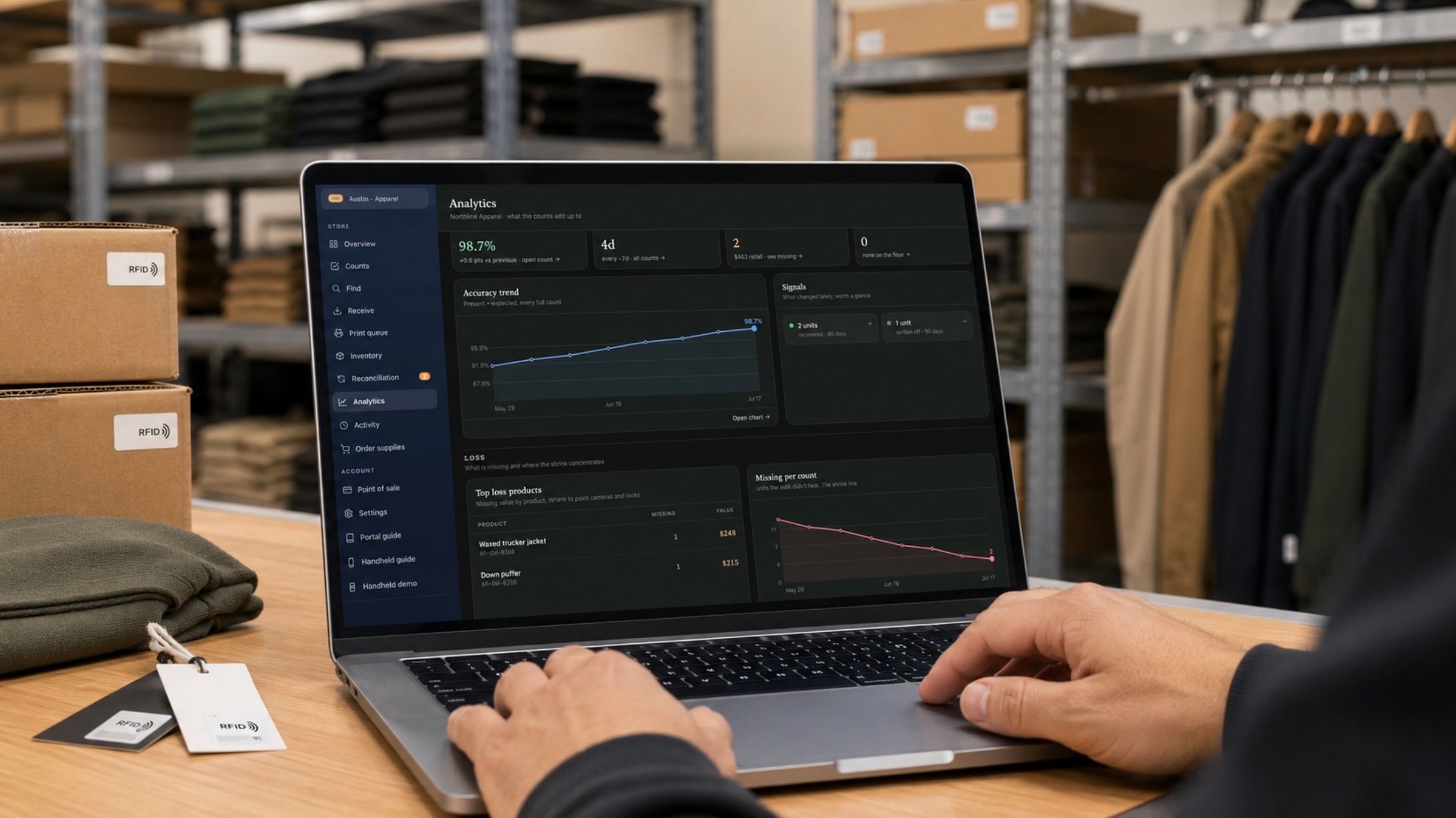
The workflow is the same one any RFID inventory program uses, sized for small high value goods. Encode a C8103 jewelry tag for each piece from the C8001 handheld or on the C8005 printer, attach it by loop or barbell, and count the cases with the C8001. indexRFID shows what is present, what is missing, and where each piece was last seen. No POS integration is required, you reconcile against the system you already run, and an optional Shopify connection can sync counts and push approved corrections back. For a single location, the starting point is the Starter Kit, and the jewelry tag is one of the three label formats it ships with.
RFID is not a science project for jewelry. It is an operating discipline, and the category’s value density makes the payback clearer than almost anywhere else in retail. Stores that count often stop losing track of their most valuable inventory. Stores that do not keep treating a slow, error prone count as a cost of doing business.